Gregory Cushing Receives Award for Work on Grocery Vault
Get link
Facebook
X
Pinterest
Email
Other Apps
Dr. Charlotta Creel presented Admissions Officer Gregory Cushing an award for all his work advising students working on the Grocery Vault. Congratulations!
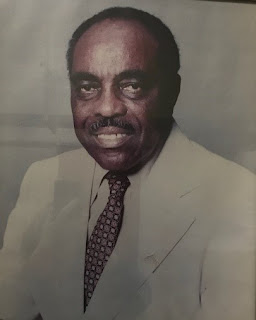
This portrait of St. Julian Devine now hangs on the second floor of the St. Julian Devine Community Center, just across from the elevator. by Susan Millar Williams, Ph. D. Those who live and work on the East Side know the name St. Julian Devine—it’s the name of the community center located in the old city incinerator, on East Bay Street between Blake and Cooper Streets. But who was the man behind the name. According to a plaque at the center, St. Julian Devine was born in Berkeley County on July 5, 1911 but moved to Charleston as a youngster because his father worked for the railroad. He was the seventh of eight children born to Frank and Sarah Wise Devine, and the only one to survive childhood. He attended Burke High School, married Priscilla Theresa Walton in 1935, and fathered ten children. He was active in the A.M.E. church and in several fraternal organizations. But St. Julian Devine’s most important claim to fame is that he served on the Charleston City Council from 19...
Please join us in welcoming our new librarian to the Downtown Palmer Campus. We are so pleased to have her with us! Valarie is from Americus, GA and has over 10 years of experience in librarianship. She comes to us from Savannah State University in Savannah, GA where she held the position of Systems/Electronic Resources Librarian. Prior to Savannah State University, she worked as the Access Services Supervisor at Georgia Southwestern State University. Valarie has a Master of Library & Information Science from Valdosta State University, a Master of Education in Instructional Technology from Georgia Southern University and a Bachelor’s degree in Business Administration/Management from Georgia Southwestern State University. She is new to the Charleston area and enjoys reading, traveling, and spending time with family and friends.
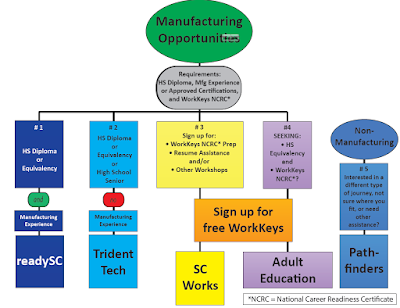
Want to be one of the 1300 new hires in manufacturing at Mercedes-Benz Vans but have no manufacturing experience? Trident Tech can help you. We are the light blue pathway in the graphic, the path you take if you have a high school credential and no manufacturing experience (if you need a high school credential or already have a high school credential and manufacturing experience, pick another pathway). Mercedes-Benz Vans, LLC (“MBV”) is a plant in Ladson, South Carolina that assembles Sprinter vans for the U.S. market under the brands Mercedes-Benz and Freightliner. The midsize Metris van was added to the assembly line in 2015. Mercedes-Benz Vans, LLC announced in March 2015 that it will invest $500 million in construction of a new Sprinter production plant, in addition to an expansion of existing operations. In July 2016, MBV officially broke ground on the site of its new plant, located next to existing operations in the North Charleston area. The MBV facility will pr...


Comments
Post a Comment